 Looking back, it should have been obvious. What we called “habits” in our toddler – lip-licking, hair-wiping, squeaks, and snorts – were tell-tale signs of Tourette Syndrome (TS) verbal and motor tics.
I knew little about TS besides a media-crafted portrayal of spontaneous, inappropriate cursing. My cutie-pie was nothing like that. In my defense, with language delays and ADHD, evident long before diagnosable by psychological standards, a few snorts and sniffs fell below the parental concern radar.
Little did I know how complex and expansive the effect of TS can be. It affected our home, school, social relationships, healthcare, and more, requiring me to become a fluent advocate and explainer of the condition.
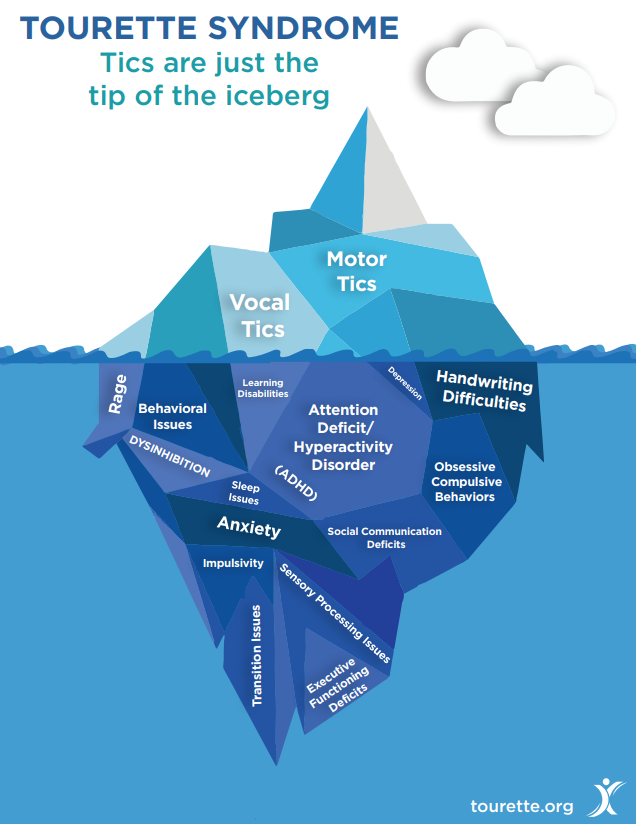
With TS, experts say that the tics are just “the tip of the iceberg,” and if you’ve met one person with TS, well, you’ve met one person with it. This neurological developmental disorder (not an injury or disease) can present differently, and the potential under-the-surface co-occurring conditions vary in type and severity. Not everyone has any or all of these. Over the years, this iceberg infographic became my go-to method of explaining to school administrators, friends, and family.
According to the Tourette Association of America (TAA):
“Tourette Syndrome is a neurodevelopmental disorder that affects children, adolescents and adults. The condition is characterized by sudden, involuntary movements and/or sounds called tics. Tics can range from mild/inconsequential to moderate and severe, and are disabling in some cases.”
TS is typically diagnosed in children after one year of recurrent, sudden, and involuntary motor and verbal tics. It does not disappear in adulthood, though the symptoms may abate. There is no cure or magic medicine to make it go away, but some medicines and medical cocktails are used to help with treatment.
My son was officially diagnosed with tics at about six or seven years old and given the TS label the following year. By then, the tics were more pronounced – bigger movements, louder noises – and evident to classmates. Yes, as you might expect, he was the target of bullying. So began a journey of switching schools and camps, lawsuits, research, experts and providers, and advocating.
A big shift occurred when my son began advocating; it gave him power and agency. The TAA and our local Chapter have a Youth Ambassador program, where youth with TS go into schools and communities to educate and increase awareness of TS. One of his early presentations was to our Town Board, who were compassionate and shared stories of their loved ones with TS. Other times, he joined other Youth Ambassadors at elementary and middle schools to teach about TS and, hopefully, inspire tolerance.
One initiative of the NY-HV Chapter of the TAA (of which I am a board member) is arranging for the Gov. Mario M. Cuomo Bridge to be lit in the color teal in honor of TS Awareness Month, which will occur this year on May 31.
May 15 – June 15 has been declared Tourette Syndrome Awareness Month in the State of New York, and we thank NYS Senator Shelley Mayer for that.
So, if, on May 31, you’re driving or walking from Westchester County to Rockland County, or the reverse, or are anywhere nearby and see the Bridge swathed in teal light, know that it is in honor of Tourette Syndrome Month. As always, be kind and tolerant.
For anyone in the New York/Hudson Valley/Fairfield County area seeking resources about TS, contact the NY/HV Chapter of the TAA at 914.378.5025 or [email protected]. Extensive resources are also available at tourette.org.
Note: This article is son-approved