














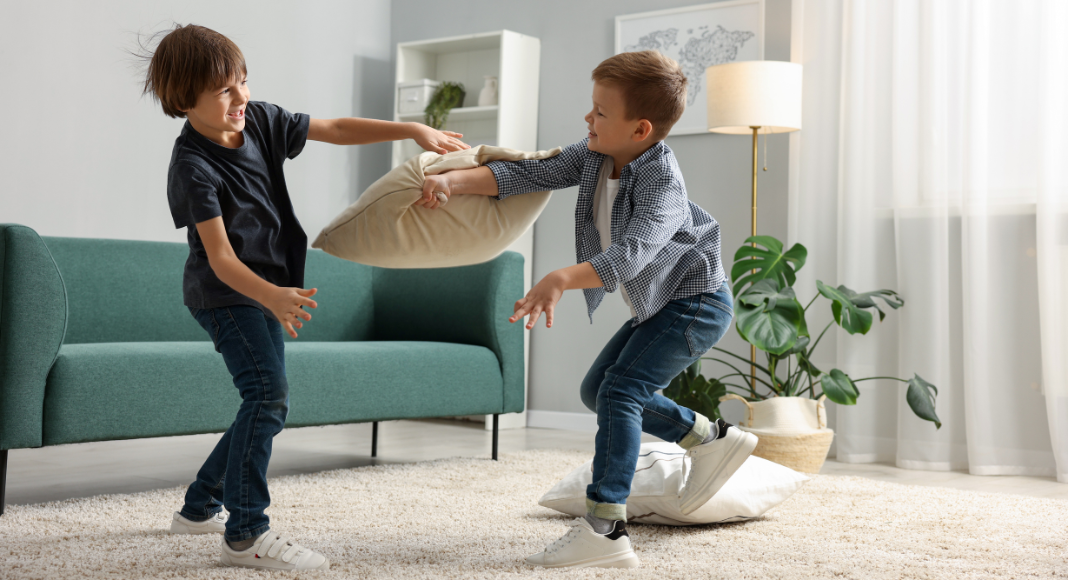
 I don’t know about you, but when my kids start fighting, it hits my nervous system like nails on a chalkboard. The raised voices, the accusations, the constant back-and-forth—it makes my whole body tense. My instinct? Shut it down immediately. Separate everyone. Restore peace at all costs, preferably with minimal involvement from me.
Once the forced apologies are mumbled and everyone storms off to opposite corners of the house, it’s tempting to assume the issue is over. Crisis averted. But over time, I’ve realized that this is actually the moment when we should be paying more attention—not to the “he said/she said,” but to what’s really fueling the bickering in the first place.
Now, I’m not suggesting we let our kids duke it out like some miniature version of Fight Club. A cool-down is still essential—for them and for us. But once emotions settle, that’s where the real work can begin.
Here’s the tricky part: kids don’t always have the language to explain what they’re feeling. Sometimes they don’t even understand it themselves. So instead of telling us what’s wrong, they show us—through behavior. When we ask, “What happened?” we usually get surface-level answers like, “She teased me,” or “He wouldn’t share.” And sure, we can lecture about kindness, respect, and sharing (again), but the same arguments keep popping up.
That’s because the real message is running underneath the fight.
At home, I noticed a sudden spike in bickering between my pre-teen daughter and my grade-school son. My daughter said her brother was constantly teasing her. My son said his sister was rude and bossy. Sound familiar? But instead of focusing on what they were saying, I started wondering why now. What had changed?
Around that time, my daughter had started putting in extra effort at school—and it showed. She was earning A’s and getting lots of positive feedback from us (because, of course, we were proud). Slowly, it dawned on me: my son felt like he wasn’t measuring up. In his eyes, his sister had become the “golden child,” and he felt invisible.
So what did he do? He poked at her until she snapped. When she got in trouble, even briefly, it felt like a win to him. If he couldn’t shine, at least he could knock her off the pedestal—even if it meant getting in trouble himself.
That realization was a gut check. Kids are always communicating with us, even when the message comes wrapped in behavior we’d rather not deal with. And while the fighting may be directed at a sibling, the message is often meant for us. Attention—positive or negative—still counts as attention.
When sibling conflict flares up, it’s worth asking: Has something shifted? Is one child feeling overlooked, insecure, or left behind—whether that feeling is real or simply perceived? Often, taking the time to truly listen to the “instigator” does far more than another lecture about being nice.
Because when kids can’t articulate what they need, they’ll act it out. And the attention we give while trying to quiet the chaos is sometimes exactly what they’re craving: our time, our focus, our interest.
Once we recognized what was happening in our home, we made a conscious effort to spotlight our son’s strengths and give him more one-on-one attention in areas where he thrived. And slowly—but noticeably—the tension eased.
For now, the storm has passed. We’re enjoying calmer days and warmer breezes…at least until the next weather system rolls in. And let’s be honest—when it comes to parenting, there’s always another one coming.









Nicely written. We certainly do have to read between the lines with our kids.
I have three kids and they are ALL so different. My oldest two are love/hate all the way. My youngest is the glue (it’s not in her to fight) she’s the neutral party.
I can see how my oldest begrudges my middle child because she took away ALL of the attention from him when she was born. AND she is a fierce defender of her choices. It’s very interesting to watch them unfold as they grow.
Thanks for your thoughts, Arlene. I’m glad the blog resonated with you and your experiences. Looking forward to reading yours!
Coren,
Great read on the Husband depression article, thanks for posting!!!
Jordan
Thanks for your feedback, Jordan! I’m really glad you enjoyed it!
Comments are closed.