My family keeps ridiculing me about an “incident” on Long Island Sound. Last summer, the five of us—myself, my husband, our dog, and two kids—took our boat to Butler’s Flat, a buzzing little clam shack on Manhasset Bay, about 20 minutes across the Sound from where we live. The line to order food at Butler’s gets exponentially longer the later you pull up to the dock. Our move is to get there early, order our crispy shrimp rolls, and pile into the boat to eat in our laps.
When it’s really nice out—as it was on this now-infamous August evening—we like to putter a little ways into the bay and drop anchor off a spit of empty, wild beach called Plum Point. After the kids scarf down their food, they jump off the boat and swim to shore to troll for treasures.
My husband and I take our time to eat, enjoying those few moments without the inability to sit still, and basking in the soft, pastel-hued dusk that makes you feel like everything will always be okay.
We were doing just that when I saw the fin.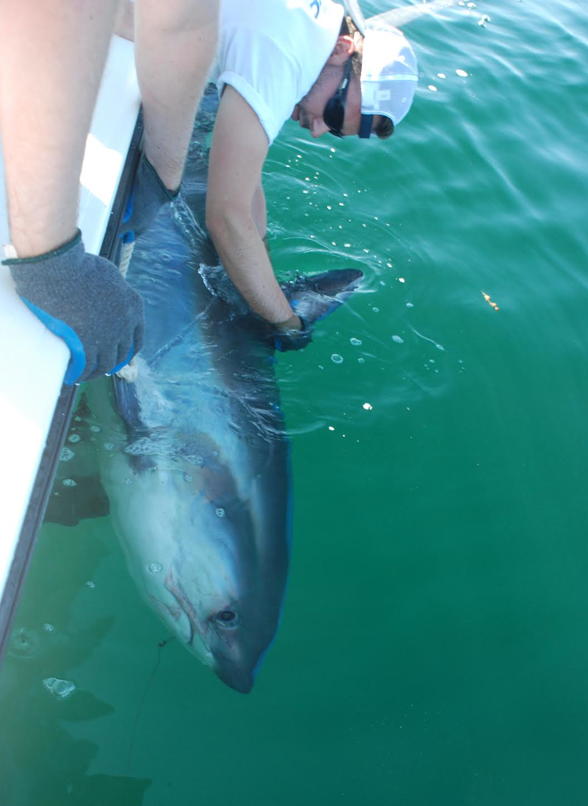
The kids had already combed the beach and were swim-floating their way back to the boat in their life jackets. I was dreamily watching the shoreline behind them, following a patch of ripples as it shimmied across the water’s surface, and remarking to myself how neat it is when minnows school up like that. And then, I kid you not, a large black triangle poked through the ripples.
It glided for a second or two and slipped back down—disappearing as smoothly and soundlessly as it had appeared. It was maybe ten inches tall, and my best guess was that it was about 30 feet behind my kids’ grinning faces.
“SHARK!!!” I screamed.
You can imagine the rest. Panic-stricken faces. Shrieks. Frantic, thrashing dog paddles back to the boat. Then ridicule.
“Mom, there’s no way you saw a shark.” My husband shook his head. “That’s like crying ‘fire’ in a crowded movie theater. You just don’t do it.” Furthermore, he pointed out, it’s impossible for sharks to be this far down in the Sound.
I was embarrassed about my reaction, but I also couldn’t let go of what I saw. So when we got home, and everyone went to bed, I went online. My internet research revealed that there are indeed sharks in Long Island Sound.
I read about a fisherman who had reeled in a 16-foot, 700-pound thresher shark off Fisher’s Island just a few weeks earlier. And reports of a nearly ten-foot great white off the coast of Greenwich in 2019. I also came across a grainy video posted to Facebook in 2018 with the subtitle, “Shark sighted in Manhasset Bay. He must have been feeding on the fish in our bay.” In it, the excited videographer follows the murky shadow of what looks very much like a shark through the shallows of the same bay where I saw my fin.
Still, the internet is the internet. While I was pleased to report back to my family that sharks actually can swim in Long Island Sound, my certainty ended there. The dinner-table banter lived on. And for a year now, my alleged shark sighting has made me the butt of too many family jokes.
So for this post, I decided to set the record straight. What is the actual deal with sharks in Long Island Sound? Could there ever be sharks in Westchester’s waters? And if so, could they be dangerous? I called two shark biologists to find out.
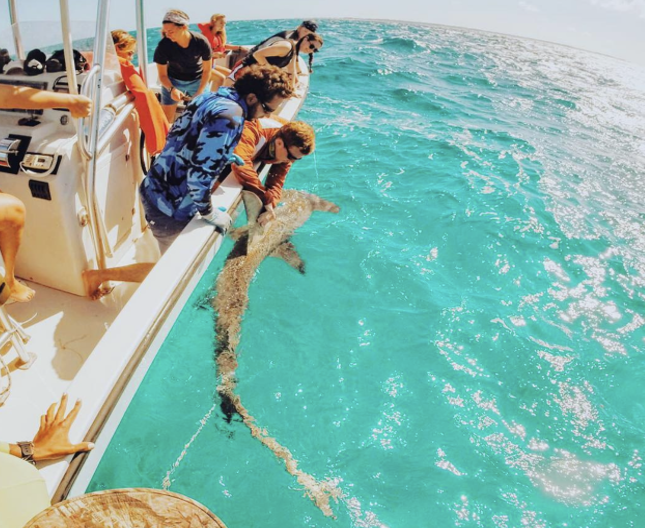
“I’m not saying what you saw wasn’t a shark,” replied the first, after hearing my play-by-play over the phone. His name is Dr. Oliver Shipley, and he’s an assistant professor at Stony Brook University’s School of Marine and Atmospheric Sciences. “But it certainly wasn’t particularly common for the Long Island Sound of today. You saw something that probably not many people have ever seen in that area. I don’t think it’s anything to be alarmed about. But it’s certainly curious.”
Shipley, who has been studying sharks in New York waters for more than a decade, pointed to the “huge salinity gradient” as you move east to west through the Sound. The waters at the western end, where we live, have a greater freshwater influence than the Atlantic Ocean, where the Sound begins. “I wouldn’t say it’s physically impossible, but the freshwater influence will constrain what you will find on average. Sharks are not going to hang around in those conditions for long periods of time.”
Shipley hadn’t heard of any credible shark reports in the western Sound. Still, when I shared the Facebook video from Manhasset Bay, he conceded it looked like a juvenile sand tiger shark, or dogfish, another type of shark.
Chris Scott, a shark biologist with the New York State Department of Environmental Conservation—and a pal of Dr. Shipley’s—told me the DEC doesn’t currently have a shark monitoring program for Long Island Sound. “There’s little data,” he said. But he added that a common thresher shark did wash up on Orchard Beach last August (not far from, ehem, Manhasset Bay). So we know it’s possible for at least thresher sharks to make it this far.
What about the 500-pound-plus great white off Greenwich?
“We contacted the researchers [tracking that shark], and they confirmed that was likely an error,” Scott told me. Biologists from OCEARCH, a global nonprofit that studies the “ocean’s giants,” had placed a fin-mounted satellite tag on a great white they named Cabot and, as Scott explained to me, there is a degree of error associated with fin-mounted tags. It is now believed that Cabot was actually swimming off the south shore of Long Island—i.e., in the Atlantic—when its tag pinged a receiver near Greenwich.
Scott was perhaps a tad more generous than Shipley in his interpretation of my fin story. “It’s very possible that what you saw was a shark,” he allowed. But he was careful to share that there are other creatures in the western Sound with (what look like) scary black triangles, too: bottlenose dolphins and cownose rays.
If my fin belonged to a shark, its owner could have been one of several species. “Sandbar, sand tiger, smooth and spiny dogfish may move through the area occasionally, but this has not been largely confirmed,” Shipley wrote in a follow-up email. And let’s not forget about the thresher.
As for how dangerous a shark in the western Sound might be to humans, Shipley said it’s not that dangerous. “There’s a database called the International Shark Attack File. We don’t like the name. We call them shark interactions because very few incidents are unprovoked. And if you look at the common culprits, those [five] species are down the list.” He added, “You’re more likely to have your ear bitten off on the subway than get bitten by a sandbar shark on Long Island Sound.”
And what should you do if you see a fin?
“Well first, not shout ‘Shark!’” Shipley laughed. “Just gradually move your way back to your boat or back to shore—whichever is closest.”
Both Scott and Shipley shared simple steps every swimmer can take to minimize their chances of a shark encounter. First, don’t swim at dawn or dusk, because these are the times when forage fish (all those little minnows) like to swim up to the surface—which in turn attracts hungry sharks.
Second, no matter the time of day, don’t swim in an area where you see schools of fish. Period.
Third, avoid murky water. “Sharks don’t want anything to do with humans,” Scott said, “but if the water is murky and there’s a school of fish, they’re going to come through and get their meal—and unfortunately you might get grazed.”
While “evidence” of sharks this far west remains largely anecdotal, we could start to see some hard data soon. As part of his work at Stony Brook, Shipley manages a network of underwater acoustic receivers in New York waters that “listen” for all kinds of creatures passing through, from striped bass to sturgeon to sharks (to activate the receiver, the animal has to have been implanted with a tag first). Most of these receivers are off Long Island’s south shore, in the Atlantic, but there are a few strings of them across eastern Sound waters (imagine the Sound as one long wrist, and the receiver networks as beaded bracelets extending from Connecticut to Long Island).
Last fall, researchers planted the first receiver network off the coast of Westchester, extending from Harrison to Glen Cove. When I asked Shipley if he’s heard anything interesting, he said not yet—partly because it takes time to collect data, and partly because it was such a cold winter, so the water is substantially colder than it usually is at this time of year. He expects to have more clarity by the end of this summer.
Still, he said, “I’m very skeptical we’ll hear anything sharky that far west.”
I hope he’s wrong. Because it’s cool to think about sharks cruising around nearby (now that I know how not to get hurt by them). And because I’m ready to put the mom jokes to bed.