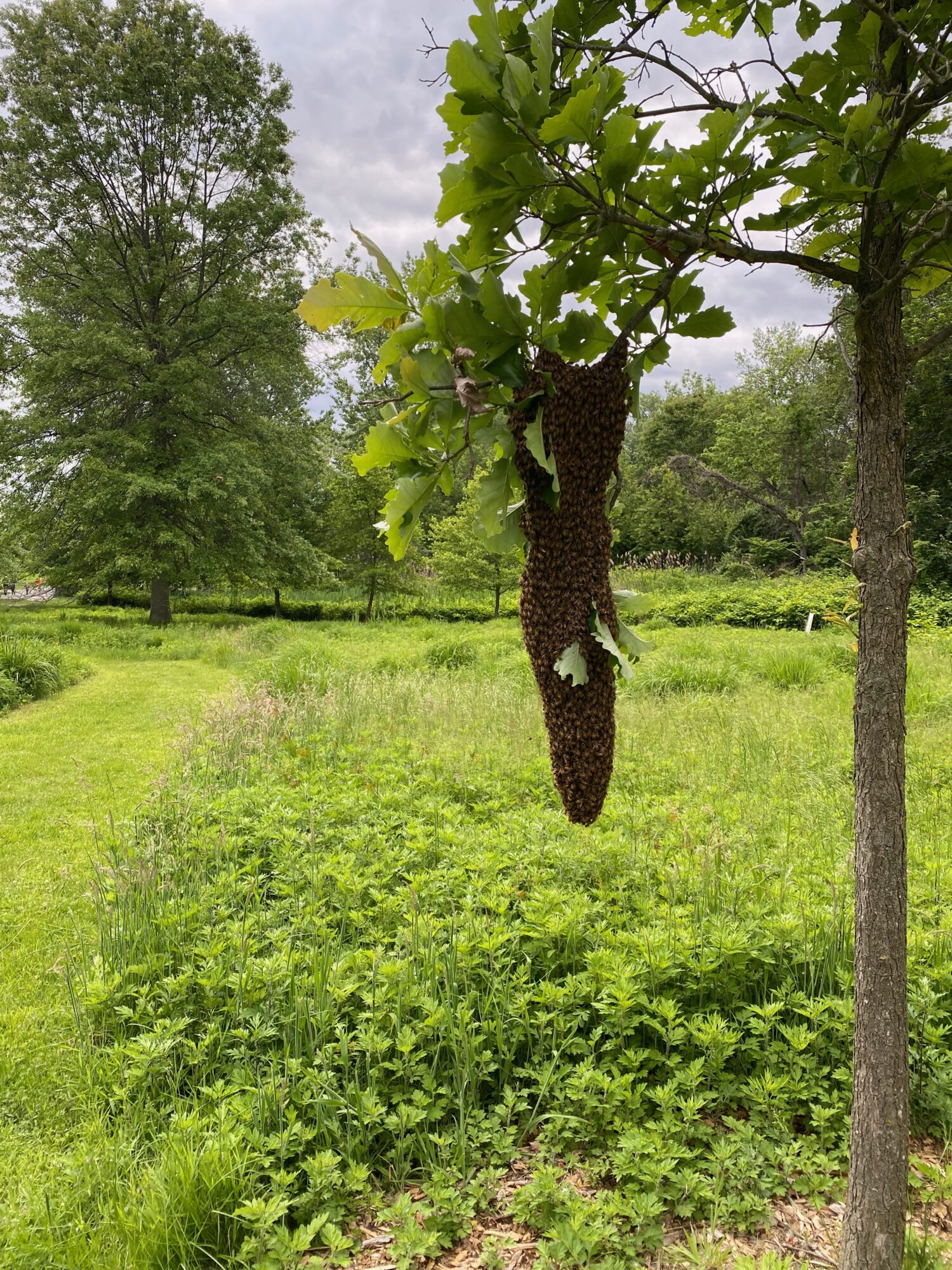
A few weeks ago, a Nextdoor post caught my eye: “Swarm season is here!” The author, whose full name I later learned was Jenya Spinner, attached a photo of what appeared to be a bulging, raisin-colored stocking dangling from a tree. Jenya wrote, “If you see a big cluster of bees hanging on a tree branch, fence post, house, etc., that’s usually a swarm…please message me! I can safely relocate them.”
Curious, I sent a message.
In Westchester County, swarm season begins in late April and lasts through June, sometimes dribbling into July. Swarms can happen anywhere. The day I called Jenya, she had just received notifications from White Plains, Yonkers, Larchmont, New Rochelle, and Ossining.
Swarms are not nearly as scary as their name sounds. In fact, bees are docile when swarming.
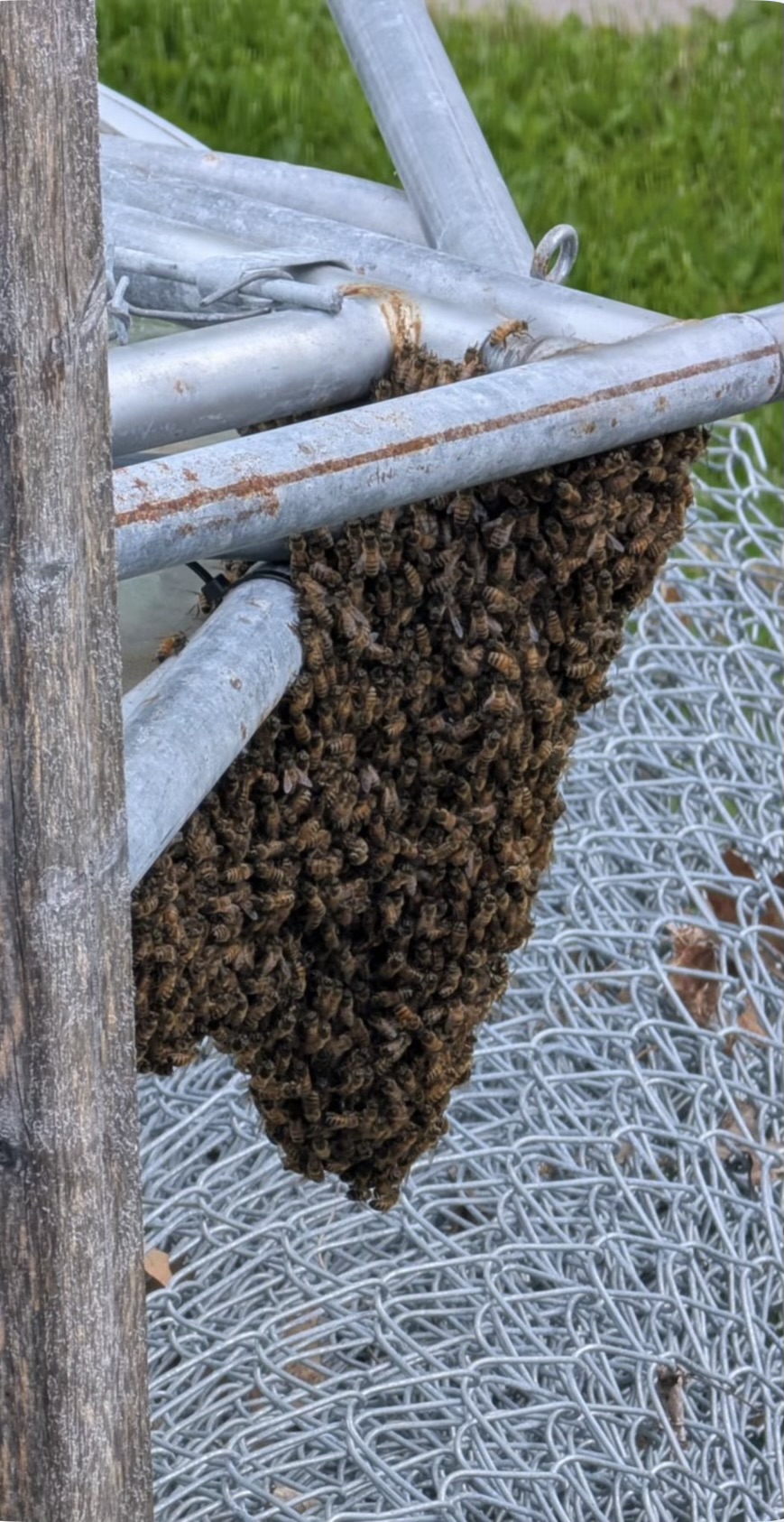
And here came another fascinating fact: the thousands of honeybees you see clustered together in a swarm are attached by their feet. They link their tiny legs together—picture a paper chain—and it’s called “festooning.”
To understand why honeybees swarm, you first have to understand how they live. Jenya—who is originally from Russia, lives in Scarsdale, and works in Larchmont—keeps 17 colonies of honeybees in her backyard with her husband, a general contractor and fellow bee enthusiast. The couple got into beekeeping a few years ago because they loved the honey Jenya’s father would send over from the bees on his farm in Russia.
Jenya speaks with a Russian accent, and when she talks about bees, her voice softens with wonder and more than a little amusement. “Every time we deal with bees, we learn more and more,” she told me. “They are beautiful creatures.”
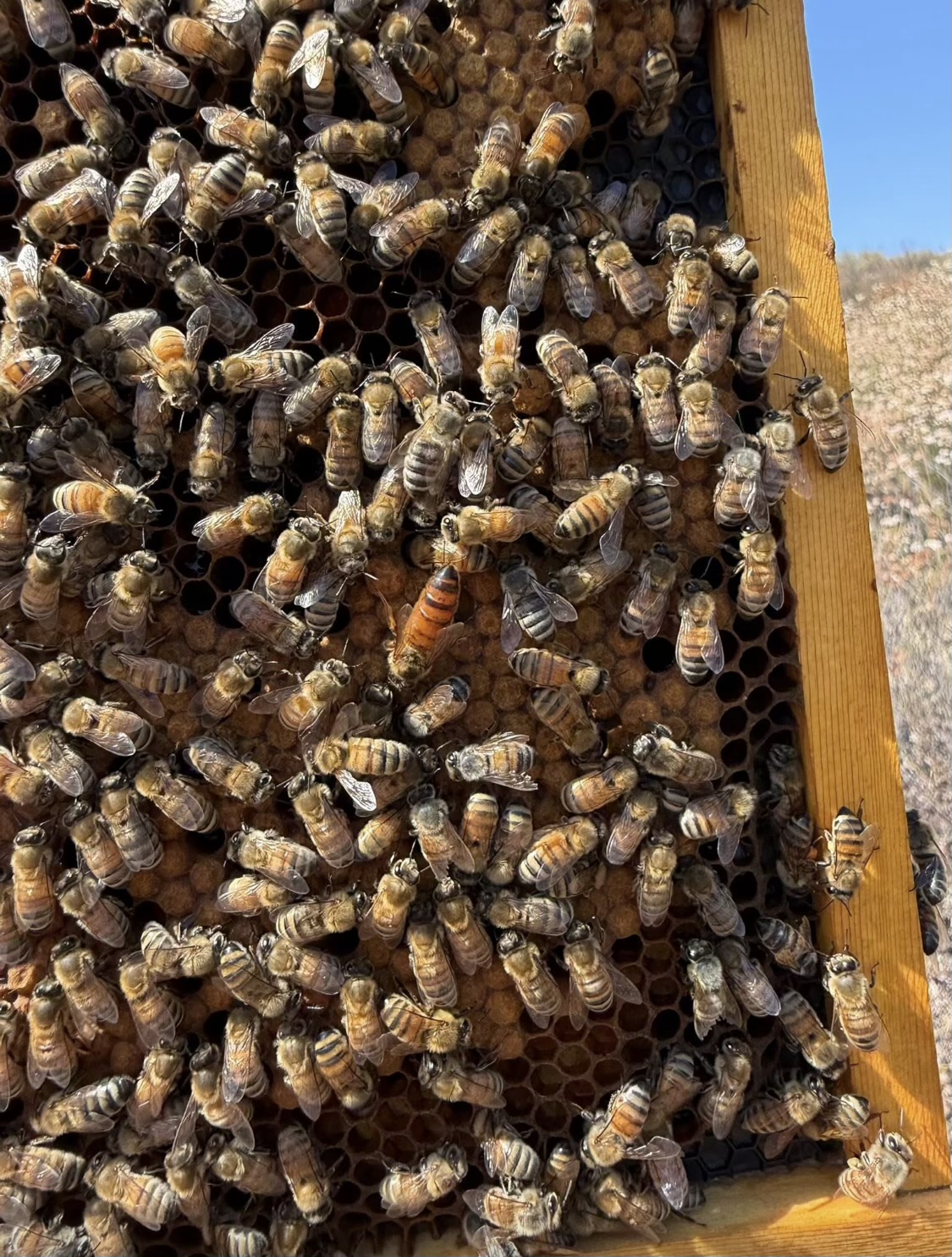
A honeybee colony has three types of bees: one queen, tens of thousands of worker bees, and, during the warmer months, hundreds of drones, or male bees. The queen’s job is to lay eggs—a good queen in her prime can lay two thousand eggs per day—and also to emit pheromones, which are chemical messages that essentially keep the colony united by letting all the bees know they are in the same family. The worker bees are female (always, no exceptions), and they do the heavy lifting. They collect nectar and pollen, make honey, build and maintain the hive, and keep everything tidy.
Jenya and I communed over this last detail. “Worker bees are very clean,” she said. “They remove debris and dead bees. They fly them out and drop them.” Worker bees never defecate in their hive. “When it’s too cold, they stay inside and hold it,” Jenya said. “They come out for a cleansing flight when it’s sunny and above 45 degrees. Sometimes you’ll see bee poop on the snow.”
And the drones? “Their only function is to mate,” Jenya said. “They don’t forage. Don’t bring food. All they do is eat and mate. Like men.” She laughed. “Like some men.”
Mating happens outside the hive. Drones gather in congregation areas about 25 feet above ground. “Like when you go to a bar to pick up a chick,” Jenya joked. Except the chick in this case is the queen. When she flies up, the hovering drones make their move. One by one, each drone mates with the queen midair—and one by one, each drone dies. For a male honeybee, mating brings sudden death. “But they die happy,” Jenya quipped.
During a mating flight, a queen will mate with about 15 drones. Then she flies back to the hive. “And that’s it,” said Jenya. “She starts laying eggs.”
Honeybee colonies can swell to more than 100,000 bees. When a colony runs out of space inside its hive, about half of it decides to leave. Hence, the swarm.
But first—and here is another incredible thing that honeybees innately know how to do—the workers raise a new queen to leave behind because no colony can survive without a queen.
Jenya estimates there are around 50,000 honeybees in a typical swarm. Many of the calls she receives are from homeowners who are afraid of bees and don’t want to get stung. But really, one might argue it is the honeybees who are in a precarious situation.
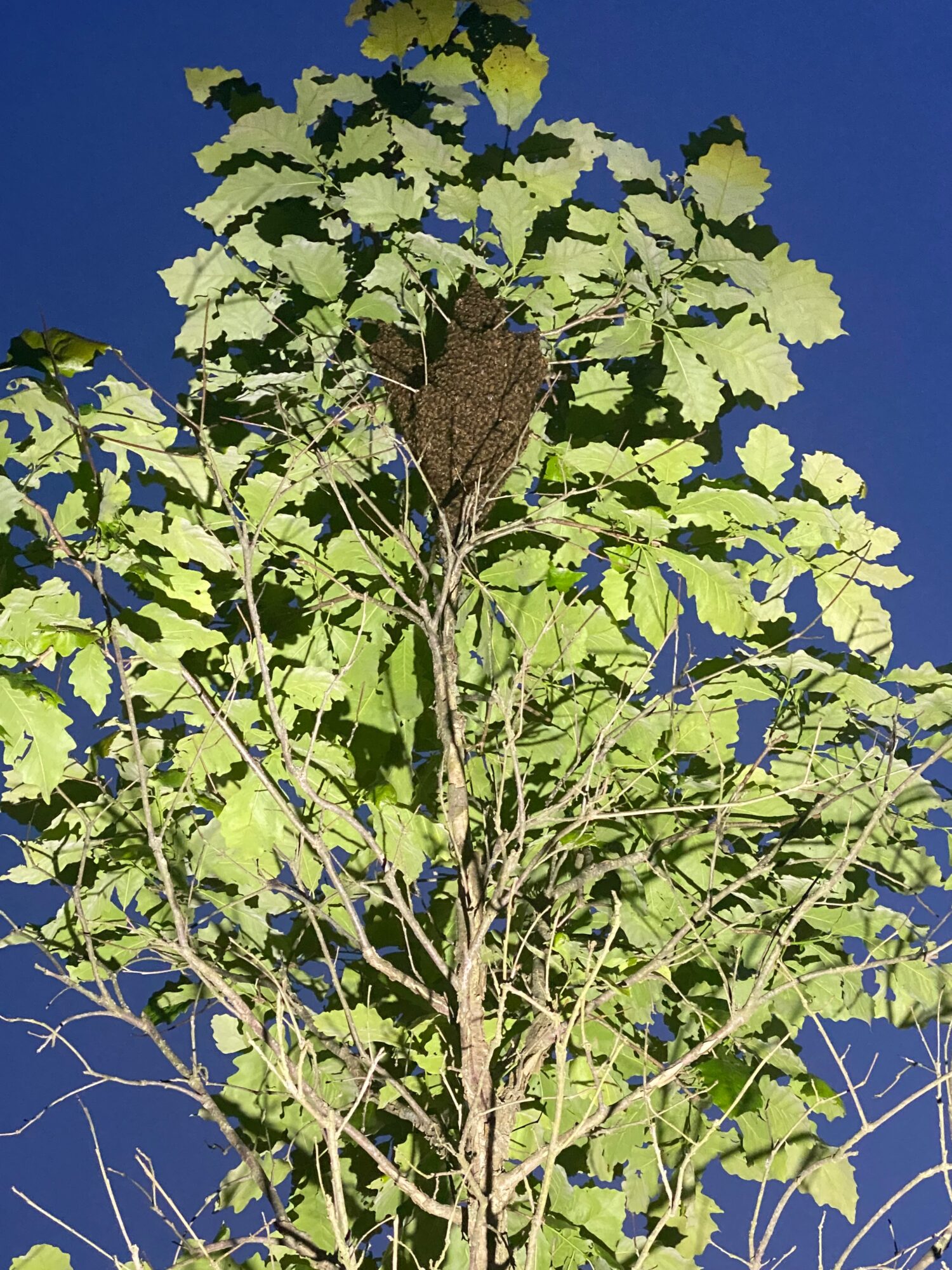
“Most swarms don’t survive,” Jenya said. “Because they find funny spots, like air conditioning units or a space that will not be a good spot for a hive in winter, and then the colony will die.”
The easiest swarms to remove are the ones that hang like sacks from tree branches. In those cases, Jenya and Dean will cut the branch and shake the swarm into a box. But sometimes the swarm is wrapped around a tree or fence—or even the side of a house—in a way that makes it impossible to shake off. So Jenya holds the box open while Dean gently brushes the bees in.
Jenya and Dean relocate swarms to places around Westchester that are more conducive to successful hives, including Ward Acres Park in New Rochelle and the Edith G. Read Wildlife Sanctuary in Rye. The latter has a special “Observation Hive” in its visitor center that affords an up-close view of honeybees in their element.
I visited the sanctuary on a full-sunshine day after my call with Jenya. To get there, you have to drive into Playland and pay the requisite $15 parking fee (unless you have a membership to Edith Read, which you can purchase online). But instead of pulling into the massive lot, you keep going, past the lurching rides and rattling Dragon Coaster, and wend to the right onto a lane that leads away from the shrieks of ride-goers and into a realm of birdsong, meadows, woods, and glimpses of the Sound shimmering blue through the trees.
When I arrived at the visitor center, there was a sign by the door that said: “Will Return.” There’s pretty much just one person who runs the space, a seventy-ish-year-old man named John, and he was doing some work on the trails that morning. (That’s one thing about the visitor center at Edith Read—sometimes John steps out, so it’s a good idea to call ahead.)
Eventually, John returned, and we stood side by side in front of the Observation Hive, which is essentially a glass-framed sheet of honeycomb that is crawling with bees. When you get close enough, you hear a steady, collective hum. John estimated there were maybe 1,500 to 2,000 bees inside, and they were all, well, busy. Some flapped their wings impossibly fast, some folded them neatly across their backs. Others picked their way across the honeycomb with their wings fully outstretched and perfectly still.
John lit up when I told him I was writing about swarms. “Have you seen one?” He asked. I confessed I hadn’t, but I was learning so many interesting things, like how the bees link themselves together with their legs to create that big beard-like shape. John said—and I am not making this up—some beekeepers hang swarms from their chins. Google it.
Swarm season is winding down now, and I still haven’t seen one. But I’m keeping my eyes peeled. If you are lucky enough to witness a swarm, you can call a beekeeper to remove it safely to a place like Edith Read, which feels worlds away but is right in our county’s backyard.
See a swarm? Find a beekeeper on the New York State Department of Agriculture and Markets’ Swarm Catcher List.