Did you know there are twenty-two Spanish-speaking countries? Some include the United States of America because of its high population of Spanish-speaking citizens. During the late 1970s, there were many Puerto Rican families living in my hometown of Yonkers, New York.
Our community celebrated the people of Puerto Rico each year with a parade. My family would sit on lawn chairs on the main avenue (South Broadway) with my mother’s parents and watch from their neighborhood. One year, I participated in the parade as a cheerleader for Seven Brothers’ Taxi Company, owned and operated by Puerto Ricans.
My father (1949-1995) was born on the island of Puerto Rico, then moved around the age of six with his mother and two older brothers to Manhattan’s Upper East Side, known as Spanish Harlem. My mother was born and raised in the South Bronx. Her parents moved from Puerto Rico to New York in the early 1940s, never returning to live on the island again.
All of my fifty-plus cousins (including three from my father’s side) and my siblings’ facial and body features vary in height, skin and eye color, hair color and texture, but we all consider ourselves Puerto Rican. However, some may have a parent from a different ethnicity.
Although at that time there were many prominent Hispanic communities across the United States, such as Mexicans in California and Cubans in Florida, I had not met many in Yonkers. It wasn’t until my father took a job in White Plains (1988), forcing us to relocate, that I became acquainted with other Hispanics.
Both my parents never denied their ethnicity, but both had assimilated into the American culture. The language was rarely spoken at home, but the food was always served. Music was always played at home, in the car, at picnics, and at barbecues. Mom loved listening and singing along to soft rock, funk, and disco. At the same time, Dad loved doing the same with country, doo wop, soul, and R&B music.
Spanish music was heard only on holidays when the family was visiting. They often brought their own vinyl or cassette tape for dad to play on his stereo system with large speakers. On occasion, Dad would bring out his conga and play along with the songs on the stereo. My parents loved to dance salsa. It’s an easy dance to learn that even the kids would join the adults, sometimes switching partners in between songs. I remember standing on my father’s grey alligator shoes while he held me while dancing.
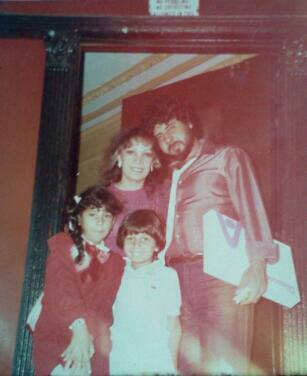
My father, who was not fluent in Spanish, spoke in his native tongue with his mother when she would call from the island where she had returned before I was born. When she visited us, she spoke only Spanish. Dad always replied to her in English.
My mother spoke Spanglish, a blend of English and Spanish words combined in a sentence, sometimes not in the correct dialect. She referred to herself as Nuyorican. It is a term formulated by Puerto Ricans from New York who were born or raised, identifying themselves after assimilating into the culture. Often, English words are spoken with a Spanish accent, such as the words taxi and soda.
Growing up, I learned the Spanish language that my mother spoke. However, it wasn’t easy for me to understand others. She often had to translate when my grandparents talked to me or shared stories. They all spoke English but preferred to communicate in Spanish. Usually, I needed to learn. They were right.
Mom would often joke that I was her American daughter. The advantage of not knowing the language allowed me to sit at the table with the adult women. I learned to keep quiet and not ask questions while in their presence. Questions were asked during our trips to the bathroom. I spent so much time with my mom that they referred to me as her shadow. This helped develop my understanding of the language, but not being allowed to speak didn’t help because I didn’t have any practice.
Embarrassed with improper pronunciation, I often shied away from speaking. I was ostracized by many of my friends’ families because I did not understand, nor could I speak, the language. I was much more accepted by people of the white and black races, whose only language was English.
Not knowing much about the Puerto Rican culture also played a huge part in not being accepted by Hispanics. Soon, my hurt turned into anger, and I became ashamed of being Hispanic.
The representation on film discouraged me from disclosing my ethnicity. Among my family, I was praised for my body features, which resembled those of famous celebrities like Iris Chacon. I was told that when I was born, I looked like an indigenous Taino (Native American) doll. As I got older, my mother began to introduce me as her American daughter to excuse the fact that I did not know how to speak or understand the language and culture.
Many began to question my mother about why I was not taught, to which she commonly attests that I didn’t want to learn. She was right. I didn’t want to know. I didn’t like the music, the food, the provocative dancing, the traditional clothing style, or anything about being Puerto Rican. I didn’t want to be associated with being Hispanic.
In school, I learned only about Mexicans. Of course, there was Ricky Ricardo (Cuban) in I Love Lucy, but we later learned he was a womanizer and an abuser. Mom often reminded us that Linda Carter, who played Wonder Woman, my childhood idol, was of Mexican descent. Dad often reminded us of Roberto Clemente, a famous Puerto Rican baseball player. But he had died before I was born. My dad didn’t watch baseball, nor did anyone else in my family, so it really didn’t change my perspective on who I was and who we were as a people, not in school nor on the who’s had anyone speak of a Puerto Rican that had made a positive contribution to the country that I had been born, raised, and loved.
As I got older, there were a few mainstream celebrities like Rosie Perez, but she didn’t look like me or anyone else in my family. Of course, Rita Moreno was praised in our home, but I never watched West Side Story. Raul Julia and a few other Puerto Rican actors began to appear on the movie screen. Ricky Martin in the 90s rose to the top of music charts, followed by Jennifer Lopez, both very passionate about their Puerto Rican heritage.
Through some of them, I started to see a reflection of me and my family. However, I was still disappointed that Puerto Ricans hadn’t made a significant contribution to the United States until the appointment of Supreme Court Justice Sonia Sotomayor. Not only was she a New Yorker, but she was also from the same borough as my mother, resembled my father’s mother, and me. She is an honorable human being, recognized and respected by many.
Finally, someone whom I could be proud to speak of when someone questions what Puerto Ricans have contributed to this country. Despite her accomplishments, many people still see Puerto Ricans as a lesser class. This negative connotation has been experienced by my husband and children, not only by people of different ethnicities but also by Hispanics.
I no longer have any family or ties to the island, but I am eager to learn about my culture, my Hispanic heritage, their stories, and the many beliefs and customs of the diverse people of Puerto Rico.
Whatever I learn, I share with my youngest daughter, whom I homeschool. Together, we are creating our own family traditions. I love how open and attentive she is in learning about her maternal lineage.
My husband, whose ancestors are from many European countries (Italy, England, Ireland, and Hungary), was raised as an American with no tradition in any one culture or ethnicity. He and his family have only spoken one language, English. For him and others, it may be okay not to know the people of your ancestors, but for me, it is now so important.
I want my children to know a part of themselves that is of Puerto Rican dissent. No matter what becomes of the island, whether it remains a territory, becomes a state, or gains independence, the culture and people stay the same.